Conventional Current and Electron Flow
Electric current is the rate of flow of electric charge through a conductor. In steady conditions, the current $I$ relates to charge $Q$ moved in time $t$ by $$I = \dfrac{Q}{t}$$ and it is measured in amperes (A), where \(1\,\mathrm{A} = 1\,\mathrm{C\,s^{-1}}\).
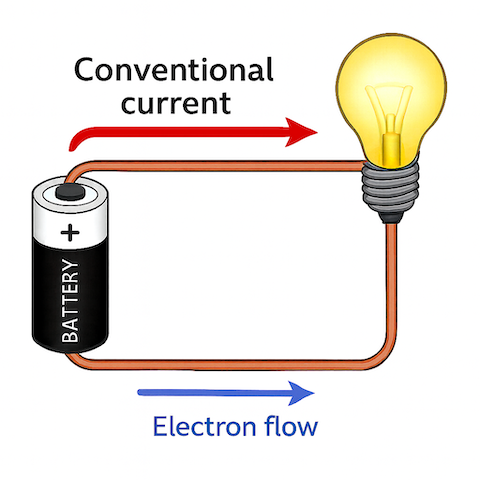
By convention, conventional current is defined to flow from the positive terminal to the negative terminal, indicating the direction positive charges would move. In metallic conductors, the actual charge carriers are electrons, which drift from the negative terminal to the positive terminal, so electron flow is opposite in direction to conventional current.
The relationship $Q = I t$ is widely used to determine how much charge passes a point in a circuit over a time interval.
For example, a steady current of \(2.0\,\mathrm{A}\) flowing for \(30\,\mathrm{s}\) transfers \(Q = 2.0 \times 30 = 60\,\mathrm{C}\).