
Right-hand rule: magnetic field around a straight wire
A current flowing through a straight wire produces a magnetic field around it in the form of concentric circles. The direction of the magnetic field can be determined using the Right-Hand Grip Rule: if the thumb points in the direction of the current, the curled fingers show the direction of the magnetic field lines.
Right-hand rule: magnetic field around a straight wire
Note that the magnetic field is represented by the symobol $B$ while current is $I$.
In the video demonstration below, a straight conducting wire is placed directly above a magnetic compass needle, and a current is passed through the wire using a connected battery circuit. As the switch is closed and the current begins to flow, the compass needle is observed to deflect from its usual north-south alignment, indicating the presence of a magnetic field generated by the current in the wire. When the current is stopped, the needle returns to its original position. This experiment visually confirms Hans Christian Oersted’s 1820 discovery that an electric current produces a magnetic field, fundamentally linking electricity and magnetism and laying the groundwork for the field of electromagnetism.
In the next video demonstration, a vertical wire is passed through a horizontal piece of cardboard, with compasses placed around the wire. When the electric current is switched on, the needles of the compasses align themselves in a circle around the wire, visually revealing the magnetic field produced by the current. When the direction of the current is reversed, the direction of the magnetic field also reverses, though the circular pattern remains the same. This demonstrates that the magnetic field lines is the form of concentric circles and their direction depends on the direction of the current, which is consistent with the Right-Hand Grip Rule.
A solenoid is a long coil of wire. When current flows through it, the magnetic field resembles that of a bar magnet, with a north and south pole. The field inside the solenoid is strong and uniform. The direction of the magnetic field can again be determined using the Right-Hand Grip Rule but this time, the thumb and curled fingers swap their roles. The curled fingers show the direction of the current in the coil while the thumb points in the direction of the magnetic field.

Magnetic field lines of a solenoid
- Increasing the current increases the strength of the magnetic field.
- Reversing the direction of the current reverses the direction of the magnetic field.
An electromagnet is made by winding a coil around a soft iron core. When current flows, it produces a magnetic field that can attract nearby objects. In a circuit breaker, the electromagnet pulls a switch to break the circuit when excessive current flows, preventing damage or fire.
The strength of the magnetic pull depends on the current flowing through the coil. When the current exceeds a safe level, the pull becomes strong enough to trigger the switch mechanism.
A latch holds the switch in place during normal operation, but when tripped, the electromagnet pulls a lever that pushes the latch away, and the spring attached to the latch keeps the contacts disconnected until the circuit breaker is reset.
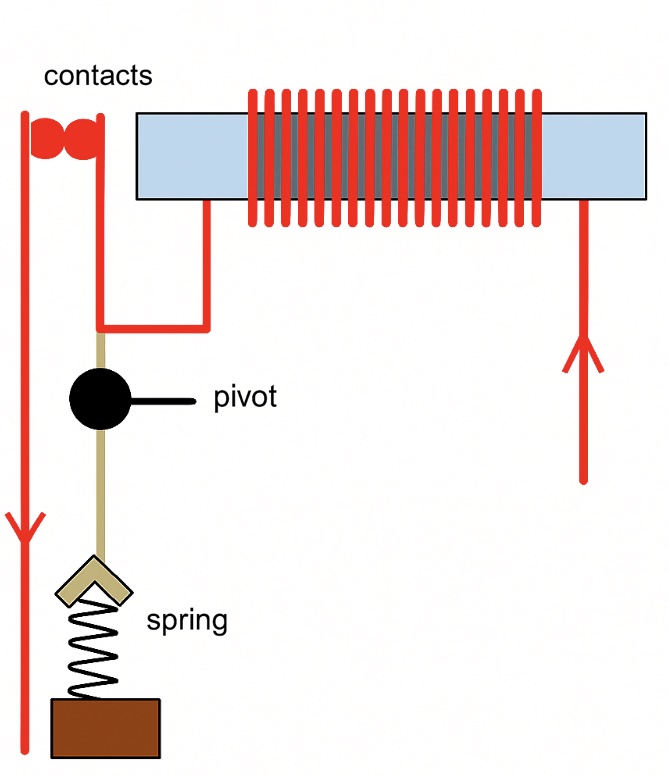
Electromagnet in a circuit breaker