Mathematically, this can be expressed as:$$n = \dfrac{c}{v}$$
The speed of light in a vacuum is a constant value, representing the maximum speed at which light can travel, which is approximately $3.0 \times 10^8$ m/s. When light travels through a medium (such as air, water, or glass), it slows down due to interactions with the particles in the medium. The speed of light in the medium is always less than the speed of light in a vacuum.
The refractive index 𝑛 is a dimensionless number that indicates how much the light slows down in the medium compared to its speed in a vacuum. For example, if the refractive index of water is 1.33, this means light travels 1.33 times slower in water than in a vacuum.
The laws of refraction describe how light (or any wave) changes direction when it passes from one medium to another. These laws are fundamental to understanding phenomena such as lenses, prisms, and the behavior of light in various materials.
The incident ray, the refracted ray, and the normal lie in the same plane
This means that the path taken by the light ray before and after refraction, as well as the normal, all lie in a single two-dimensional plane.
The ratio of the sine of the angle of incidence $\theta_i$ to the sine of the angle of reflection $\theta_r$ is constant and is equal to the ratio of the refractive indices of the two media.
This can be expressed mathematically as: $\dfrac{\sin \theta_i}{\sin \theta_r} = \dfrac{n_r}{n_i}$
or equivalently, $n_i \sin \theta_i = n_r \sin \theta_r$
where:
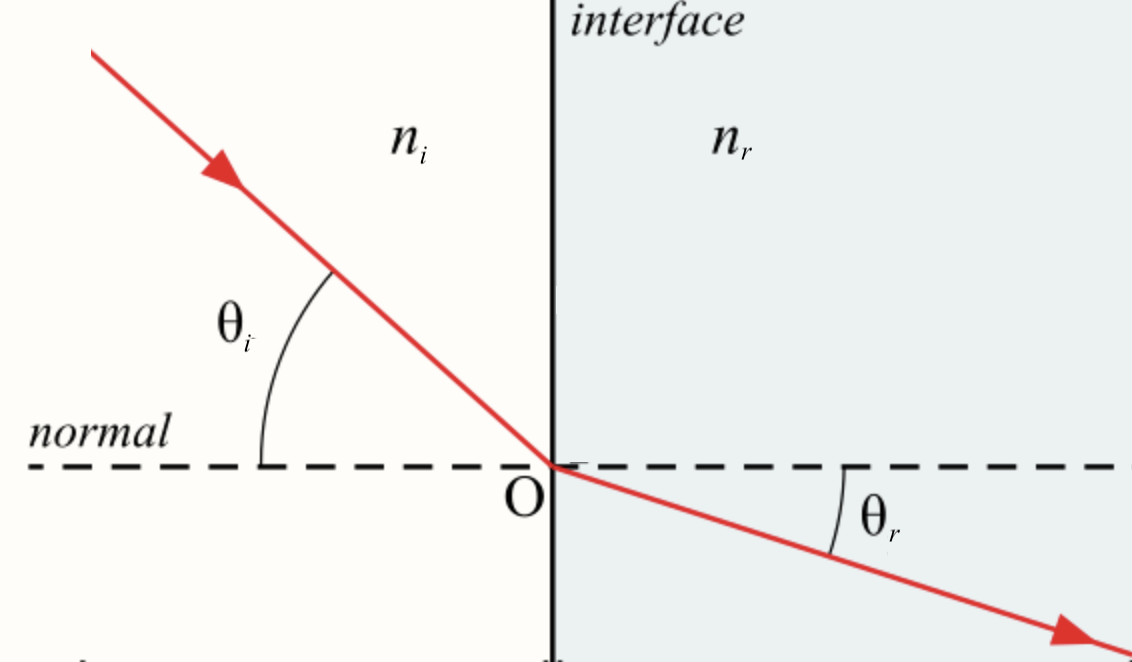
Consider light traveling from air ($n_1 = 1$) into water ($n_2 = 1.33$). If the angle of incidence in air is $30 \degree$, calculate the angle of refraction in water.
A refracted image is formed when light passes through a boundary between two different media, changing direction due to the change in speed of light in each medium. Here are the key characteristics of a refracted image:
Using the simulation below, adjust the positions of the object and eye to observe how the rays of light reaches the eye from the object. The eye is assumed to be in air. The refractive index of the medium in which the object is round can be varied using the slider. You can also adjust the position of the eye. It will appear that the image alway looks closer than the object if the light is coming from a medium with higher refractive index.
You can use the following interactive to practise calculations involving Snell's law. Use the pink slider to change the quantity to find. Adjust the refractice indices using the sliders to vary the values in the question. You can also shift the origin of the incident ray.