
Density is the amount of mass per unit volume. It is typically denoted by the symbol ρ (rho)
$$\rho = \dfrac{m}{V}$$ where $\rho$ is the density,The standard unit for density in the International System of Units (SI) is kilograms per cubic metre (kg m-3.
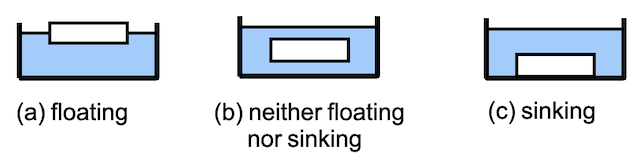
When an object is placed in a liquid, the density of the object relative to that of the liquid determines whether it sinks or floats. Objects with:
The pressure due to a column of liquid, often referred to as hydrostatic pressure, is a result of the weight of the liquid above a given point in a fluid column. The pressure due to a liquid column = height of column × density of the liquid × gravitational field strength
The hydrostatic pressure at a certain depth in a fluid is given by the equation:
$$P = \rho g h$$where:
$\rho$ is the density of the liquid,
$g$ is the acceleration due to gravity,
$h$ is the depth of the point below the surface of the liquid.
In the figure below, water pressure at a specific depth in a fluid is determined by the weight of the water above that point. When a hole is made at a lower position, the depth (and therefore the pressure) is higher. Higher pressure results in a higher initial velocity of water, causing it to travel a greater distance before hitting the ground.
A diver goes from a depth of 10 m to 100 m underwater. Assuming that the gravitational field strength is 10 N kg−1, and the density of sea water is about 1030 kg m−3, determine the change in water pressure.