The principle of moments states that for a body to be in equilibrium, the sum of the clockwise moments about any axis must be equal to the sum of the anticlockwise moments about the same axis.
To apply this principle to new situations or solve related problems, follow these steps:
Identify the pivot point or axis about which moments are to be calculated.
Determine all the forces acting on the object and their respective distances from the pivot point.
Calculate the moment of each force by multiplying the force by its perpendicular distance from the pivot.
Categorize the moments into clockwise and anticlockwise directions.
Sum up all the clockwise moments and all the anticlockwise moments.
For the object to be in equilibrium, set the sum of the clockwise moments equal to the sum of the anticlockwise moments and solve for any unknowns.
Sample Problem
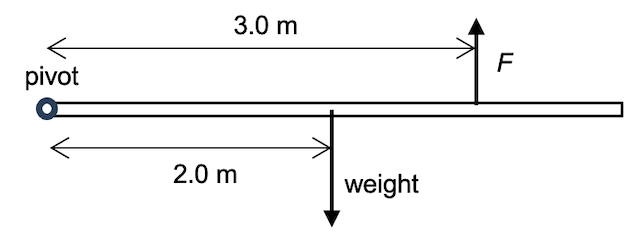
A uniform beam of length 4.0 m and weight 200 N is pivoted at its left end and in equilibrium. A vertical force $F$ is applied at a distance of 3.0 m from the left end of the beam. The weight of the beam acts vertically downward at its center.
Determine the magnitude and direction of the force $F$ required to keep the beam in equilibrium.
Solution:
According to the principle of moments, the sum of the clockwise moments is equal to the sum of the anticlockwise moments for a body in equilibrium.
Taking moments about the left end of the beam, clockwise moment is due to the weight of the beam at its centre at a distance of 2.0 m from the pivot.
Therefore, it must be balanced by an anti-clockwise moment due to force $F$ at a distance of 3.0 m from the chosen pivot. The direction force $F$ must be upward, as shown in the diagram below.
Since, sum of clockwise moments = sum of anti-clockwise moments,
200 N × 2.0 m = F × 3.0 m F ≈ 133 N (upward)